
Social Aspects of Soviet Modernization in Kazakhstan: The Role of Housing Policy (1920s-1980s)
Research Article
Views: 344 / PDF downloads: 204DOI:
https://doi.org/10.32523/3080-129X-2026-155-2-179-201Keywords:
housing policy, distribution mechanisms, regional features, housing standards, housing shortage, housing construction cooperativesAbstract
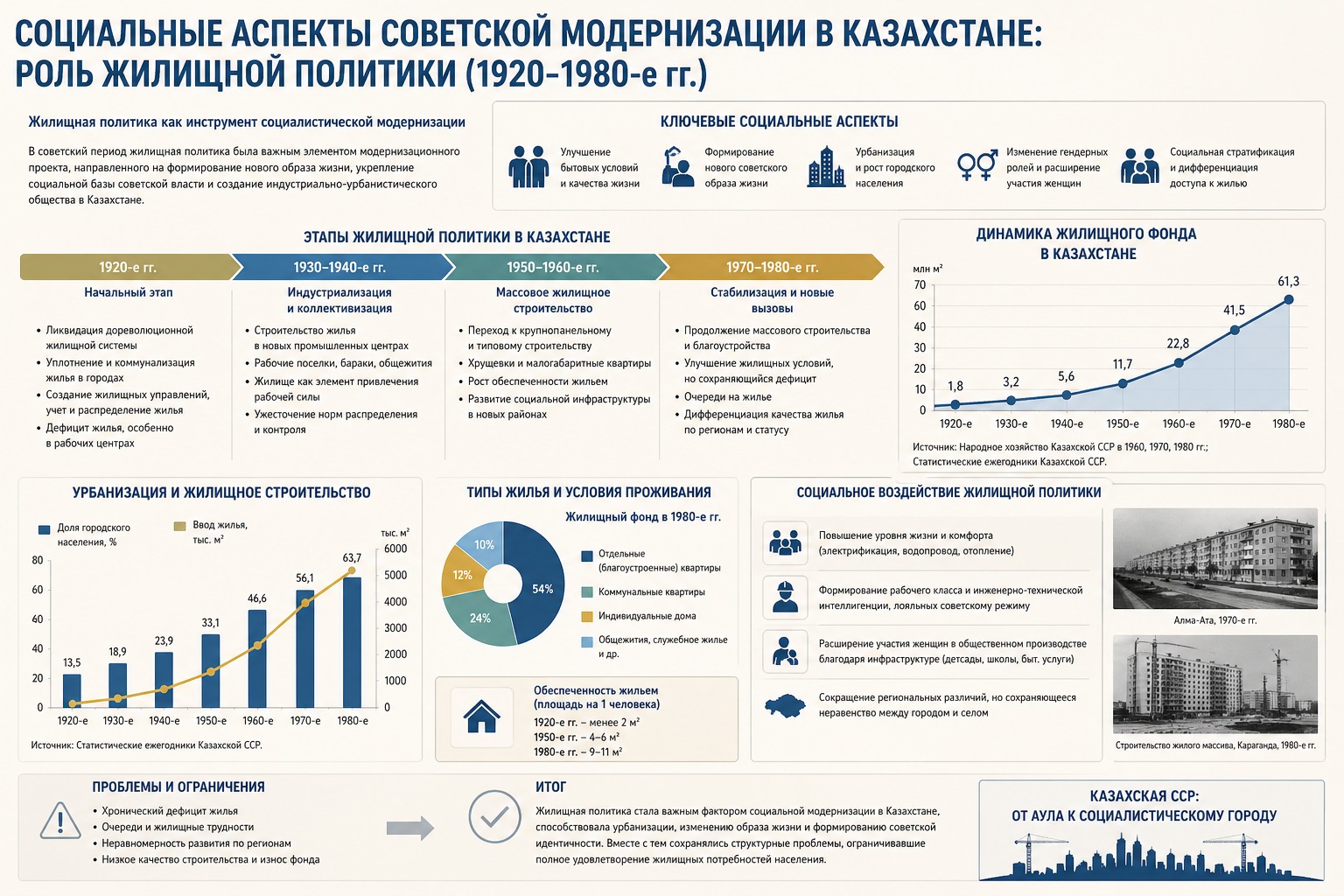
The article offers a comprehensive analysis of housing policy as a key mechanism of social modernization in Kazakhstan during the 1920s‒1980s, examining it within the broader context of the formation of the Soviet model of social order. The study focuses on the transformation of housing conditions, settlement patterns, and principles of housing allocation, which functioned not only as social measures aimed at improving living standards but also as instruments of state regulation, control, and integration of the population into the Soviet socioeconomic system. The authors argue that housing policy was one of the most effective channels for shaping a new social structure, since access to housing‒its type, quality, and location‒determined opportunities for professional advancement, the degree of inclusion in the urban environment, and participation in industrial production processes. The article identifies several stages in the development of housing policy. The municipalization of the housing stock marked the 1920s, the redistribution of prerevolutionary urban spaces, and attempts to construct a new model of “socialist everyday life.” In the 1930s‒1950s, a centralized system of state housing distribution emerged, closely linked to industrialization, migration flows, and the development of new industrial centers in Kazakhstan. Particular attention is given to the Khruschev modernization of the 1950s–1960s, when mass housing construction became a major instrument of accelerated urbanization and social mobility, enabling a significant portion of the population to move from barracks and adobe dwellings to standardized apartments. In the subsequent decades, housing policy continued to serve as an important regulator of social stratification, although resource shortages, regional disparities, and growing waiting lists for housing constrained its effectiveness. The methodological framework of the study includes the analysis of legal acts, statistical data, and archival materials, as well as the use of historical-comparative and problemchronological approaches. This comprehensive methodology makes it possible to identify both all-Union trends and regional specificities shaped by levels of industrialization, ethnodemographic dynamics, and settlement patterns in Kazakhstan. The study demonstrates that housing policy contributed to the formation of new models of everyday life, changes in family structures, the consolidation of Soviet identity, and the emergence of a distinct urban culture. The conclusion substantiates that housing policy in Kazakhstan was a crucial component of Soviet modernization, combining the functions of resource redistribution, social integration, disciplinary control, and the construction of a new social order. It not only defined material living conditions but also served as an instrument for shaping Soviet society, influencing social mobility, labor structures, and the nature of state–society relations.
Downloads
References
Martin T. The Affirmative Action Empire. Nations and Nationalism in the Soviet Union, 1923-1939. Ithaca-Londres: Cornell University Press. 2001. 496 p.
Absadykov A. Ot iurt do vysotnykh zdanii. Alma Ata: Kazakhstan.1967. 54 p.
Bakanov S., Khlyzov V. Vsesoiuznaia perepis zhilishchnogo fonda SSSR 1960 g.: organizatsiia i itogi. The modern history of Russia. 2023.Vol.13, no.3, p.482-499. DOI: https://doi.org/10.21638/spbu24.2023.215
Veselovsky B. Kommunalnoe khoziaistvo v tsifrakh i diagrammakh 1917-1927 gg. Moscow: NKVD of the RSFSR. 1928. 467 p.
Vostrov V., Kauanova H. Materialnaia kultura kazakhskogo naroda na sovremennom etape. Alma Ata: Science. 1972. 236 p.
Goroda Kazakhstana v 20-30-kh gg. XX veka kak sotsiokulturnyi fenomen: etno-demograficheskoe i sotsialno-kulturnoe razvitie: Collection of archival documents and materials. Almaty: Nurly Alem. 2025. 400 р.
Goroda Tsentralnogo Kazakhstana v 1950-1960-e gody. Karaganda. 2017. 224 p.
Dvoretsky S. Zhilishchnaia problema v SSSR i puti ee resheniia. Moscow: Profizdat. 1990. 31 p.
Dmitriev N. Zhilishchnyi vopros: dva mira ‒ dva podkhoda. Scientific editor Yu. Voznesensky. Moscow: Moskovsky rabochy. 1973. 208 p.
Istoriia gorodskoi povsednevnosti Tsentralnogo Kazakhstana v 1946-1991 gody (s siuzhetami demograficheskoi i sotsialnoi istorii): Saktaganova Z., Abdrakhmanova K., Dosova B., Kozina V., Eleukhanova S., Karsybayeva Zh., Utebayeva A. Karaganda: "Glazir". 2017. 456 p.
«Sviaz i televidenie na sluzhbe naroda» (peredovaia statia). Kazakhstanskaya pravda. 1976. January 28th.
"Pod znamenem Pobedy – k novym uspekham" (peredovaia statia k 9 maia). Kazakhstanskaya pravda. 1977. May 7.
Kauanova H. Obraz zhizni i byt rabochikh semei: (Na materialakh Kazakhstana). Alma Ata: Science. 1982. 166 p.
Kobalevsky V. Zhilishchnoe stroitelstvo v piatoi piatiletke. Moscow: Gospolitizdat. 1954. 80 p.
Lebina N. Povsednevnaia zhizn sovetskogo goroda: normy i anomalii. 1920-1930 gody. Moscow: New Literary Review. 2015. 488 p.
Meerovich M. Zhilishchnaia politika SSSR s 1917 po 1941 g. CLIO. 2009. No.2. pp.65-78.
Narodnoe khoziaistvo Kazakhstana. Statistical collection. Alma Ata. 1957а.
Narodnoe khoziaistvo Kazakhstana v 1976 g. Statistical collection. Alma Ata. 1977.
Narodnoe khoziaistvo Kazakhskoi SSR. Statistical collection. Stat. Administration of the Kazakh SSR. Alma Ata. 1957b.
Narodnoe khoziaistvo SSSR v 1960 g.: Statistical Yearbook. Moscow: Statistics. 1961.
Nikolaev A. Zhilishchnoe stroitelstvo v shestoi piatiletke. Moscow: Gospolitizdat. 1956. 96 p.
Pilipenko I. Dinamika zhilishchnogo stroitelstva v respublikakh SSSR v 1920-1980-e gg. Historical and economic research. 2022. Vol.23, no.1, pp.7-43.
Sailaubay Е., Alimgazinov К. Formirovanie pasportnoi sistemy v Karagandinskoi oblasti v 1930-e gody. Gumilyov Journal of History. 2025. Vol.152, no.3, pp.186-07, https:/doi.org/10.32523/3080-129X-2025-152-3-186-207
Slezkin Y. SSSR kak kommunalnaia kvartira. In: American Russian studies: Milestones in the historiography of recent years. The Soviet period. Comp. M. David-Fox. Samara: Samara University. 2001. 376 p.
Fitzpatrick S. Povsednevnyi stalinizm. Sotsialnaia istoriia sovetskoi Rossii v 30-e gody. Moscow. 2001. 478 p.
Fuko M. Nuzhno zashchishchat obshchestvo. St. Petersburg: Nauka Publ. 2005. 312 p.
Fuko M. Intellektualy i vlast. Chast 1. Izbrannye politicheskie stati, vystupleniia i interviu 1970-1988. Moscow: Praxis. 2002. 388 p.
Hall S. Vopros kulturnoi identichnosti. Art magazine. 2010. No.77- 78. URL:ttp:/xz.gif.ru/numbers/77-78/hall
Downloads
Published
Issue
Section
License
Copyright (c) 2026 A. Kapayeva, S. Asanova

This work is licensed under a Creative Commons Attribution-NonCommercial-NoDerivatives 4.0 International License.