The northern republics in the demographic landscape of Russia
Research Article
Views: 1206 / PDF downloads: 764DOI:
https://doi.org/10.32523/3080-129X-2026-155-2-96-118Keywords:
northern republics, population, demographic landscape, ethnic groups, assimilation, interethnic marriagesAbstract
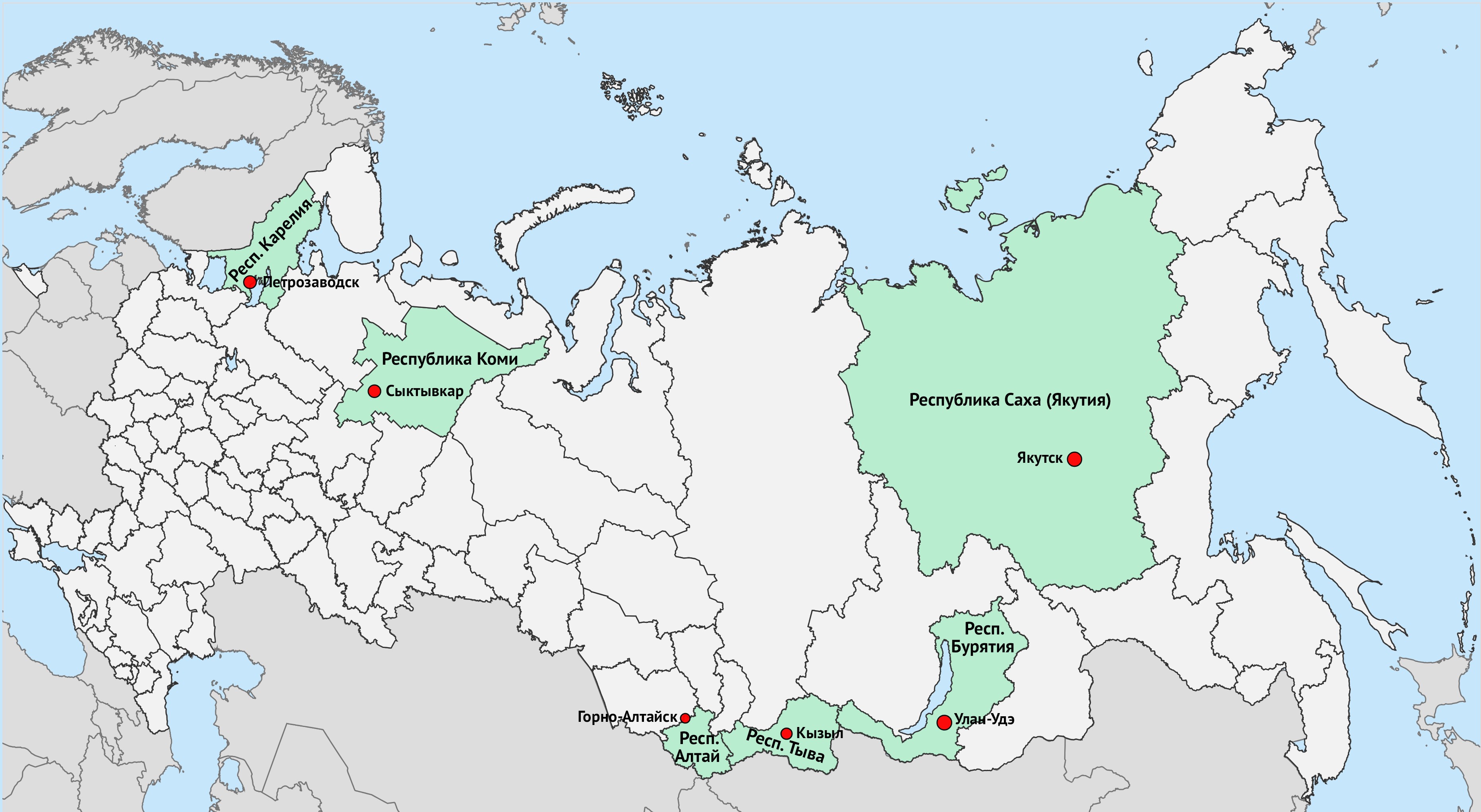
The study is devoted to the demographic development of the northern republics of Russia, located in the European North – the Republics of Karelia and Komi; in the Asian North – the Republics of Sakha (Yakutia) and Tyva; in the southern part of Western Siberia – the Altai Republic; in Eastern Siberia – the Republic of Buryatia. All the named republics differ from other subjects of the Russian Federation in that they owe their names to the titular ethnic groups that constituted the ethnic majority during the period of their formation. In economic terms, all the titular republics have rich deposits of various minerals, which made them attractive for colonization and involvement in economic circulation at the beginning of the 20th century. In the 1930s and 1950s, all the republics became part of the Gulag economy, which radically changed their traditional way of life and economic activities. The article is based on current statistics and population censuses (1926-2021). On this basis, the transformation of the population dynamics of six republics is revealed: some republics demonstrated an increase in their numbers, others – a population decline, and there were also multidirectional dynamics. The importance of considering this issue is that the population dynamics of the republics determine their demographic potential and opportunities for economic development and the exploration of new territories. It is shown that along with external migration flows that have disturbed the demographic structures of the population (there are more men and disproportions in the age structure have arisen); the problems of the titular ethnic groups are examined in detail, the problems are revealed, how, from the dominant ethnic groups before the 20th century, they became both absolute and relative ethnic minorities. Economic expansion has led to a decrease in the territory of indigenous ethnic groups. The place of the northern ethnic groups in the national structure of the peoples of Russia was considered separately. According to the 2021 population census, the Yakuts occupied – 17th place, the Buryats – 19th, the Tuvans – 24th, the Komi – 33rd, the Altaians – 43rd, the Karelians – 56th. The issues of settlement of titular ethnic groups are examined in detail. It is noted that most of them live in rural areas and in their ethnic homeland. The Materials from the All-Russian Population Census 2021, «On the distribution of married couples by nationality of the spouses» represent novelty and scientific contribution; this data is being introduced into scientific circulation for the first time. It has been shown that people living in ethnic republics enter into same-ethnic marriages more often than those living outside of them. Karelians and Komi people are most likely to get married across national borders; it is noted that the spread of interethnic married couples leads to assimilation, the dissolution of small ethnic groups into larger ones. It should be noted that only a small part of the problems of the titular ethnic groups has been considered; it remains to be studied the problems of marriage and conscious loneliness, why civil marriages (cohabitation) leading to low birth rates are becoming widespread, and why the number of divorces and illegitimate births is increasing.
Downloads
References
Ares F. Chelovek pered litsom smerti. Per. s fr. Obshch. red. Obolenskoi S.; Predisl. Gurevicha A. Moscow: Progress Publishing Group – Progress-Academy. 1992. 528 p.
Beznosova N., Zherebtsov I., Sablin V. Migratsii naseleniya Komi avtonomii v 1920-1930-e gody. Proceedings of the Komi science centre, Ural branch, Russian academy of sciences. 2023. No.8, pp.44–51. DOI: https://doi.org/10.19110/1994-5655-2023-8-44-51
Buryaty. Nimaev D. i dr. Moscow: “Nauka” Publ. 2004. 633 p.
Demograficheskie i migratsionnye protsessy na Rossijskom Severe: 1980-2000 gg. Fauzer V., Lytkina T., Fauzer G. Syktyvkar: Pitirim Sorokin Syktyvkar State University Press. 2016. 168 p.
Zherebtsov I. Komi: ot oblasti k respyblike. Proceedings of the Komi science centre, Ural branch, Russian academy of sciences. 2016. No.3, pp.15-22.
Zherebtsov I. Istoriografiya rabot po demografii, ekonomike truda I sotsiologii, vypolnennyh na materialah Respubliki Komi i Severa Rossii. Historical demography. 2017. No.1, pp.87-98.
Zherebtsov I., Lejman I. Sozdanie Komi avtonomii kajk rezultat natsionalnoj politiki bolshevikov. History. Journal of Belorussian state university. 2021. No.4, pp.44–53. DOI: https://doi.org/10.33581/2520-6338-2021-4-44-53
Zherebtsov I., Fauzer V. Vserossijskaya perepis naseleniya 2021 goda o rasselenii narodov Kavkaza na territorii Respubliki Komi. Proceedings of the Komi science centre, Ural branch, Russian academy of sciences. 2024. No.10, pp.60-70.
Istoriko-demograficheskie issledovaniya v Respublike Komi (1980-e – 2016 gg.). Zherebtsov I. L., Menkovskij V.I., Taskaev A.M. Syktyvkar: IYaLI Komi NTs UrO RAN Publ. 2016. 24 p.
Istoria karelskogo naroda. Kirkinen H., Nevalajnen P., Sihvo H. Petrozavodsk: “Bars” Publ. 1998. 321 p.
Istoriya Komi s drevnejshih vremyon do sovremennosti. Zherebtsov I., Popov A., Taskaev M., Turubanov A. dr. Syktyvkar: “Anbur” Publ. 2011. Vol.2. 688 p.
Narody Povolzhya i Priuralya: Komi-zyryane. Komi-permyaki. Marijtsy. Mordva. Udmurty. Zherebtsov I., Konakov N., Shabaev Yu. i dr. Moscow: “Nauka” Publ. 2000. 579 p.
Pribaltijsko-finskie narody Rosii. Aksyanova G., Zubov A., Dolinova N. i dr. Moscow: “Nauka” Publ. 2003. 671 p.
Razvitie etnicheskih protsessov v Respublike Komi. Popova L.A., Fauzer V., Rozhkin E. Syktyvkar. 2001. 20 p.
Rossijskaya i Mirovaya Arktika: naselenie, ekonomika, rasselenie. Fauzer V.V., Smirnov A., Lytkina T., Fauzer G. Moscow: “Politicheskaya entsiklopediya” Publ. 2022. 215 p.
Tatarkin A., Zakharchuk E., Loginov V. Sovremennaia paradigma osvoeniia i razvitiia Arkticheskoi zony Rossiiskoi Federatsii. The Arctic: ecology and economics. 2015. No.2(18), с.4-13.
Tyurkskie narody Vostochnoj Sibiri: Tuvintsy. Tofalary. Dolgany. Funk D. i dr. Moscow: “Nauka” Publ. 2008. 422 p.
Tyurkskie narody Sibiri. Valeev F., Lvova E., Tomilov N., Funk D. i dr. Moscow: “Nauka” Publ. 2006. 678 p.
Fauzer V. Vliianie mezhnatsionalnykh brakov na assimiliatsiiu korennykh narodov Severa. VI All‑Russian Demographic Forum with International Participation: Proceedings (Moscow, December 2–3, 2025). Ed. by T. Rostovskaya; Federal Research Center for Sociology of the Russian Academy of Sciences (FNISC RAS). Vologda: Vologda Research Center of the Russian Academy of Sciences. 2025. Pр.69-71.
Fauzer V. Korennye narody Severa Rossii. Ekaterinburg: UrO RAN Publ. 2025. 308 p.
Fauzer V. Respublika Komi na rubezhe vekov: demografiya, migratsiya, rasselenie. Izhevsk: "Print” Publ. 2023. 308 p.
Fauzer V., Zherebtsov I. Kolonozatsiya Respubliki Komi: rol etnucheskoj komponenty. Syktyvkar. 2023. 36 p.
Fauzer V., Smirnov A., Fauzer G. Demograficheskaia dinamika i transformatsiia sistemy rasseleniia na Severe Rossii v koordinatakh perepisi naseleniia 2021 goda. North and Market: Formation of Economic Order. 2023. No.1, pр.64-79.
Fauzer V. Demoraficheskij potentsial severnyh regionov Rossii. The economy of Russian East. 2017. No.1, pp.41-46.
Fauzer V., Lytkina T., Fauzer G. Migratsionnyj factor dinamiki chislennosti i etnicheskih struktur naseleniya Rossijskogo Severa. North and market: the formation of an economic order. 2017. No.5, pp.32-43.
Fauzer V., Lytkina T., Fauzer G. Gosudarstvennoe upravlenie migratsiej naseleniya: ot prinuzhdeniya k pooschreniyu. Corporate governance and innovative development of North’s economy. 2015. No.3, pp.151-168.
Yakuty (Saha). Alekseev N., Romanova E., Sokolova Z. Moscow: “Nauka” Publ. 2012. 599 p.
Downloads
Published
Issue
Section
License
Copyright (c) 2026 V. Fauzer, I. Zherebtsov

This work is licensed under a Creative Commons Attribution-NonCommercial-NoDerivatives 4.0 International License.