Local elections in the Kazakh SSR as an instrument of political mobilization: a regional case of the Pavlodar Irtysh region (1920–1930s)
Research Article
Views: 302 / PDF downloads: 244DOI:
https://doi.org/10.32523/3080-129X-2026-154-1-160-177Keywords:
Kazakhstan, history, Soviet period, elections, regional case study, electoral campaignsAbstract
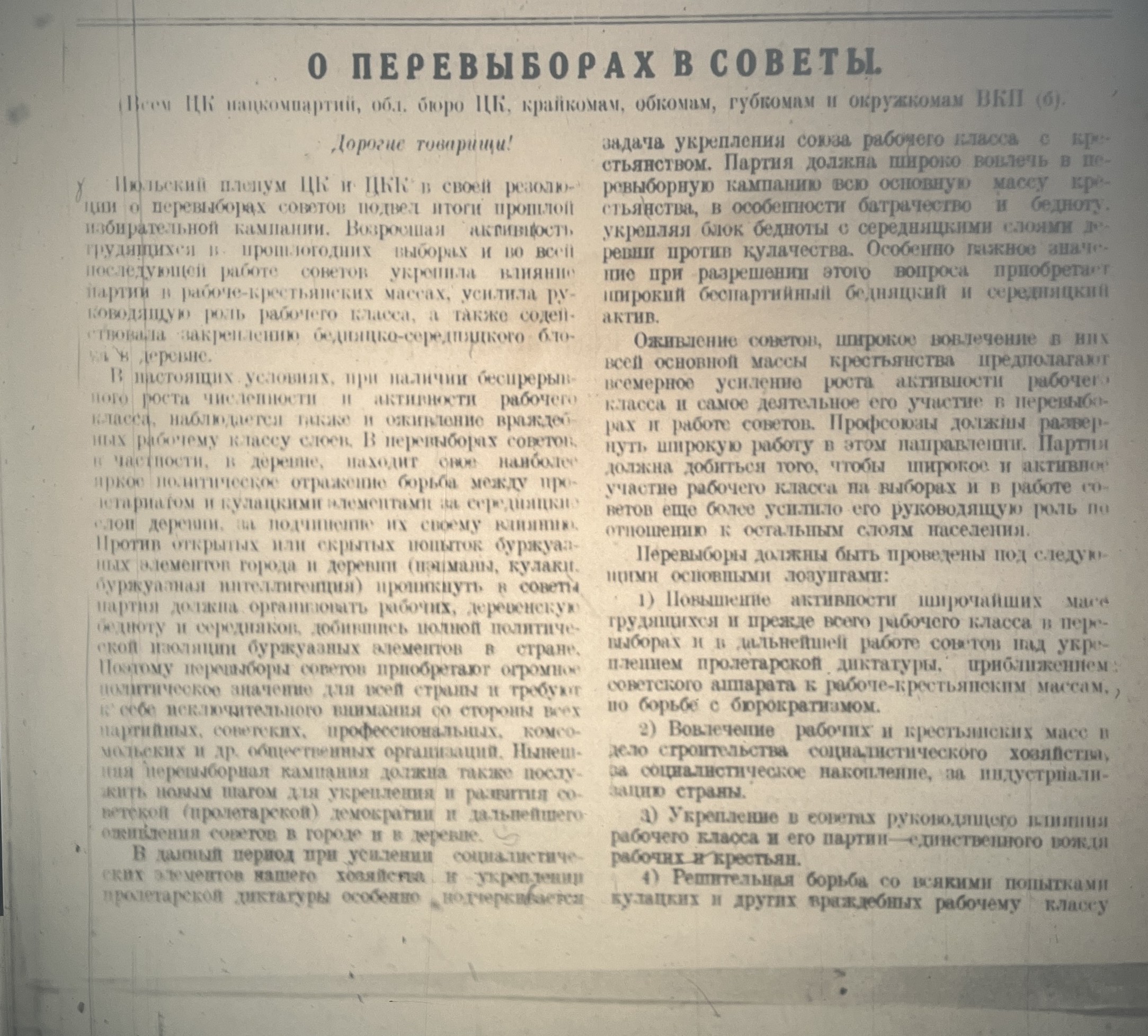
This paper examines the evolution of the electoral system in the territory of Kazakhstan in the 1920s ‒ 1930s. Considering that the institution of elections under the Soviet system was formed on the basis of the specific principle of non-alternativeness (lack of choice) and was consistently entrenched both in the center and locally, attention should be paid to the conditions of its formation, the regulatory framework, and the specifics of its dissemination. The country's population was integrated into the new realities of political life when, according to the Constitution, citizens gained the right to participate in the life of the state; however, at the same time, a certain part of them was deprived of this right if their involvement with "exploitative elements" was revealed. Ideologization, proclaimed equality, and harsh repressive policies became characteristic components of the country's electoral system as well. Under these conditions, the state authorities carried out extensive organizational work to promote the new model of electoral campaigns; a large number of people were involved in agitation activities among candidates and electors, and corresponding literature was developed. At the same time, it is necessary to point out the colossal financial resources spent on organizing the entire election procedure. The aim of the research is related to the analysis of the history of preparing and conducting electoral campaigns in the Kazakh SSR in the 1920s ‒ 1930s, identifying their features, problems, and contradictions, as well as assessing the role of elections in the process of forming the Soviet political system in the region. A distinctive feature of this work is also the regional aspect of studying the stated issues. To achieve the aim and the set tasks, archival materials from the fonds of the State Archive of the Pavlodar Region (Pavlodar City Executive Committee of Workers', Peasants', and Red Army Deputies; Pavlodar Uyezd Committee of the Medical Sanitary Labor Union; Pavlodar District Executive Committee of Soviets of Workers', Peasants', and Red Army Deputies) were used, specifically within the framework of regulatory acts of authorities, reports of local executive committees, and electoral commissions. The source base of the research also included Soviet-era journals, analyzed from the perspective of their coverage of this topic. In the course of analyzing the historiography on the topic of the work, the main approaches, problems, and directions of its study were identified. Thus, the institution of elections to the Soviets became part of the process of "Sovietization" of society. These processes unfolded in parallel with a wide range of state-initiated campaigns of the period, such as the eradication of illiteracy, korenizatsiya (indigenization), anti-religious measures, and other initiatives aimed at reshaping the socio-political order and incorporating broad segments of the population, including residents of auls (villages), into newly constructed systems of social relations. Within this context, electoral practices acquired a ritualized character, serving as a symbolic mechanism through which citizens were formally integrated into political life.
Downloads
References
Ablazhej N., Zhanbossinova A. The Election Campaign and the Tribal Confrontation in the Kazakh ASSR. Vestnik of Saint Petersburg University. History. 2025. Vol.70, no.2, pp.421–444. https://doi.rg/10.21638/spbu02.2025.209
Anisimova I. Formation of the Soviet Power in Kazakhstan and Realization of the Policy of Indigenization of Administrative Facilities in 1920-1926. Izvestiya of Altai State University. 2017. No.2(94), pp.21‒27 DOI: https://doi.org/10.14258/izvasu(2017)2-02
Balykova A. The history of population registration in 1920-1923. East European Scientific Journal. 2015. Vol.2, no.3, pp.70-72.
Berljavskij L., Bondarev V. Election Campaign of 1937 for the Elections to the Supreme Sovietof the USSR: Legislation and Practical Implementation in the Rostov Region. Legal order and and legal values. 2025. No.3(2), рр.9-22. DOI: https://doi.org/10.23947/2949-1843-2025-3-2-9-22
Borisov O. Formation of the electoral system of the Soviet state. Scientific notes of the Orel State University. Ser.: Humanities and Social Sciences. 2009. No.3, pp.194-196.
Il'inyh V. Elections to the Soviets in the RSFSR under the Conditions of the NEP: Features and Results of Election Campaigns in 1922–1929. Historical Courier. 2024. No.1(33), pp.36-48. DOI: https://doi.org/10.31518/2618-9100-2024-1-3
KHow is the polling station organized? The propagandist. 1937. No.23, рр.22‒23. https://www.booksite.ru/election/03_st-65.html
Kemelbekov A. Organization of local government in Kazakhstan in the period 1917-1933 . (historical-j and legal aspect). Legal science. 2019. No.9, pp.12‒17.
Kozybaeva M., Kaipbaeva A. Political repressions and marginalized people in the cities of Kazakhstan in the 1920s–1930s: legal status and problems of adaptation of disenfranchised people Asian Journal “Steppe Panorama”. 2024. No.11(2), pp.411‒423. DOI: https://doi.org/10.51943/2710-3994_2024_38_2_411-423
Salamatova M. Election commissions of the RSFSR (1918-1936): features of legal regulation. Historical and legal problems: A New Perspective. 2014. No.10, pp.58‒76.
Salamatova M. The Institution of Disenfranchisement in Soviet Russia: from the 1918 Constitution to the 1936 Constitution. Historical and Legal Problems: A New Perspective. 2018. No.3, pp.125-144.
Sapasheva E. Disenfranchisement in 1920-1930. Thought 2024. https://mysl.kazgazeta.kz/news/16142
What is an electoral district? The propagandist. 1937. No.23, pp.20-22. https://www.booksite.ru//election/03_st-76.html
Published
Issue
Section
License
Copyright (c) 2026 A. Turlybekova, N. Baigabylov, Ye. Sailaubay

This work is licensed under a Creative Commons Attribution-NonCommercial-NoDerivatives 4.0 International License.