
To the study of artistic metal of the Kimaks
Research аrticle
Views: 158 / PDF downloads: 120DOI:
https://doi.org/10.32523/3080-129X-2026-156-3-34-51Keywords:
East Kazakhstan, the early Middle Ages, Kimaks, art metal, decorations, stylization, ornamentAbstract
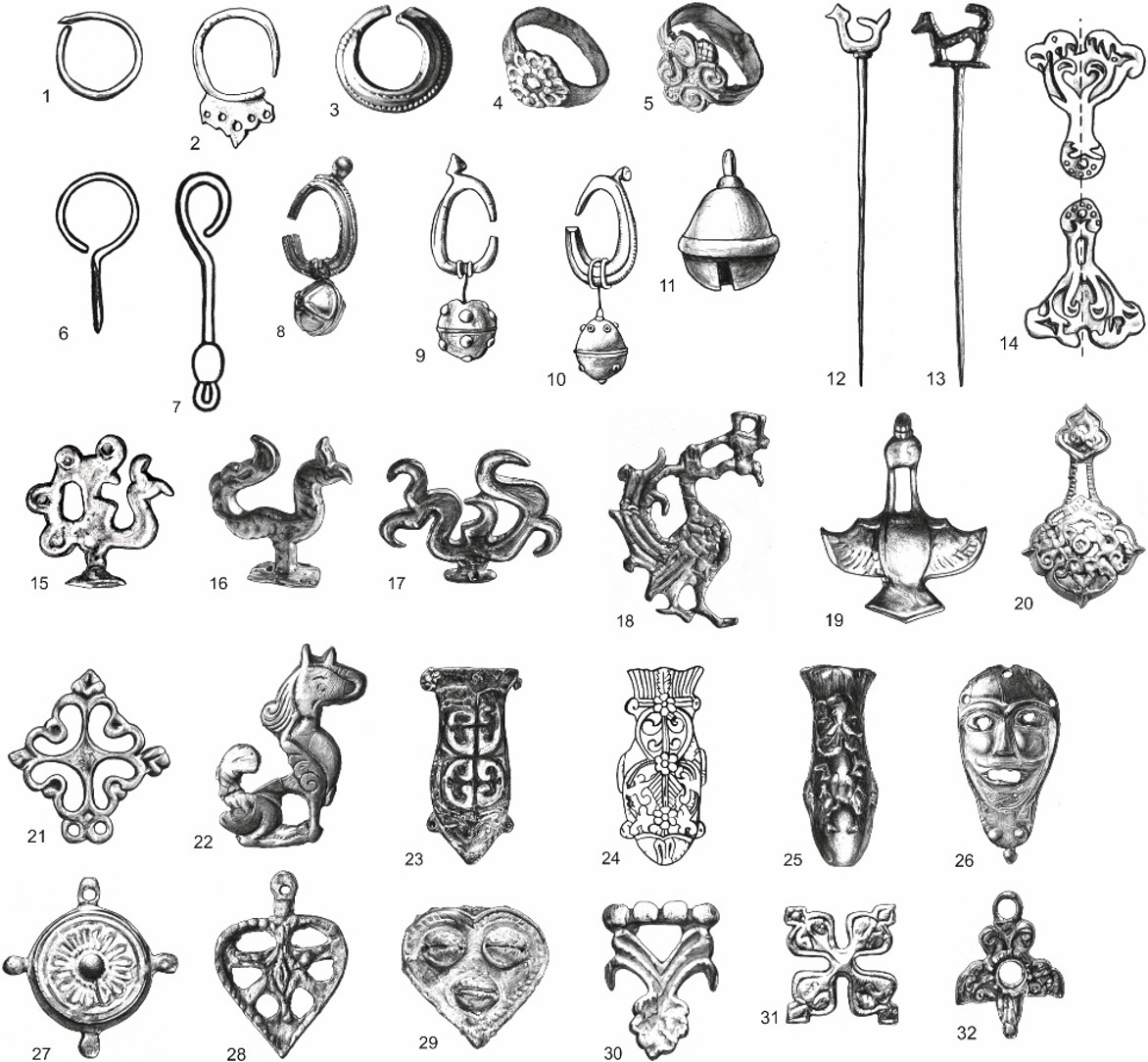
When solving the problems of the cultural and creative process of the early Middle Ages, out of the field of view of researchers remained material on toreutics, originating from the burials of Kimaks – one of the Turkic-speaking tribes, which occupied a vast territory from Tobol and Irtysh to the Caspian and Syr Darya, but after three centuries disappeared. Accordingly, the chronological framework of the work covers a period that includes the time of the emergence of the Kimak Kaganate at the end of the IX century and its decline in the middle of the XI century under pressure from the Mongol tribes of Central Asia. The circumstances and conditions for the discovery of metal objects, their description, general assessment, interpretation, and reconstruction options are given in a number of publications by F.Kh. Arslanova, who studied medieval mounds in Pavlodar and Upper Irtysh (late 1950–1970s). Another valuable source was a monograph on the results of work in the flood zone of the Shulba hydroelectric station, carried out in the 1980–1983 expedition of the Institute of History, Archeology and Ethnography, Ch. C. Valikhanov Academy of Sciences of the Kazakh SSR. However, in these works, no attempts were made to analyze the art historical nature. At the same time, a relatively large collection of things identified in Kimak burials, including jewelry of belt and blasting sets, jewelry for the head and hands, cult affiliation, requires a holistic consideration, systematization, and analysis of technologies, decor, and visual range. In this article, we tried, relying on the most striking items in the collection, to touch on these issues and show the values that the Kimak people have enriched humanity with. For this, a more accurate drawing of products has been undertaken, which allows you to identify sufficiently significant details. A typological analysis of the belt and jet headset was carried out with the selection of three types of buckles (brushless, with a movable and fixed shield), with the systematization of blades (overhead, end, suspended), and with the selection of original forms. Visual analysis of the forms and design techniques of the warrior's accessories showed that they were inherited from the early nomads. Such clear contours are characteristic of the traditional nomadic technique of application. The decor of the products also traces the features characteristic of the style of art of the early medieval era as a whole – convention and schematism, plane-relief drawing, axial and central symmetry. Analysis of ornamentation on samples made it possible to distinguish two main groups: linear-geometric and floral ornament. And here continuity is traced, and preference is given to three universal motifs (trefoil, palmette, heart), on the basis of which many variations have been created. Among the identified Kimak ear ornaments, five types have been identified. On this basis, the structural, decorative, and evolutionary features of nomadic earrings are considered, and the hypothesis of their genesis is presented. An attempt was made to use ethnographic reality data to interpret cult objects from female burials of the Upper Irtysh region. It was revealed that the costume of the Kimak woman-shaman symbolized a bird, the role of feathers, legs, and claws of which was played by metal pendants depicting zoomorphic and anthropomorphic figures.
Downloads
References
Ageeva E.I., Maksimova A.G. Otchet Pavlodarskoi arkheologicheskoi ekspeditsii 1955 g. Proceedings of the Institute of History, Archaeology and Ethnography of the Academy of Sciences of the Kazakh SSR. Alma-Ata: Academy of Sciences of the Kazakh SSR Publ. 1959. No.7. Pp.32-58.
Arslanova F. Ocherki srednevekovoi arkheologii Verkhnego Priirtyshia. Essays on Medieval Archaeology of the Upper Irtysh Region. Materials and Research on the Archaeology of Kazakhstan Samashev Z. (ed.). Astana: Branch of the Margulan Institute of Archaeology Publ. 2013. Vol.3. 406 p.
Arkheologicheskaia karta Kazakhstana. Akishev K.A. (ed.). Alma-Ata: Academy of Sciences of the Kazakh SSR Publ. 1960. 449 p.
Arkheologicheskie pamiatniki v zone zatopleniia Shulbinskoi GES. Alma-Ata. 1987. 280 p.
Bernshtam A.N. Istoriko-arkheologicheskie ocherki Tsentralnogo Tian-Shania i Pamiro-Alaia. Materials and Research on the Archaeology of the USSR. No. 26. Moscow–Leningrad. 1952. 348 p.
Bokovenko I.A., Zadneprovskii Yu.A. Rannie kochevniki Vostochnogo Kazakhstana Steppe Belt of the Asian Part of the USSR in Scythian-Sarmatian Time. Moscow: Nauka Publ. 1992. Pp.140-148.
Vladimirov G. Sergi v vide znaka voprosa iz srednevekovoi Bolgarii (XIII-XIV vv.): o materialnykh sledakh kumanov i Zolotoi Ordy v kulture Vtorogo Bolgarskogo tsarstva. Kazan. 2018. Pp.10-38.
Gorelik M.V. Kultura imperii, sozdannykh kochevnikami (skify, khazary, mongoly). Archaeology of the Eurasian Steppes. 2017. No.5, рp.253-256.
Deopik V.B. Klassifikatsiia i khronologiia alanskikh ukrashenii VI-IX vv. Materials and Research on the Archaeology of the USSR. No.114. Moscow: Academy of Sciences of the USSR Publ. 1963. Pp.123-147.
Zadneprovskii Yu. Rannie kochevniki Semirechia i Tian-Shania. Steppe Belt of the Asian Part of the USSR in Scythian-Sarmatian Time. Moscow: Nauka Publ. 1992. Pp.73-87.
Zadneprovskii Yu.A. Rannie kochevniki Iuzhnogo Kazakhstana i Tashkentskogo oazisa. Steppe Belt of the Asian Part of the USSR in Scythian-Sarmatian Time. Moscow: Nauka Publ. 1992. Pp.101-107.
Zakharov Yu.A. Mir shamana-tselitelia. Moscow: Yauza Publ. 1998. 256 p.
Zakharov Yu. Praktika shamana-tselitelia. Moscow: Yauza Publ. 1998. 256 p.
Karazhigitova А., Peresvetov G., Kabyldinov А. Pogrebenie srednevekovogo voina v Pavlodarskom Priirtyshe. Gumilyov Journal of History. 2025. Vol.151, no.2, pp.29-42, https://doi.org/10.32523/3080-129X-2025-151-2-29-42. DOI: https://doi.org/10.32523/3080-129X-2025-151-2-29-42
Korol G.G., Naumova O.B. Khudozhestvennyi metall u kochevnikov (Tsentralnaia Aziia rubezha I-II tys.). Moscow: IA RAS Publ. 2017. 128 p.
Kumekov B.E. Gosudarstvo kimakov IX-XI vv. po arabskim istochnikam. Alma-Ata: Nauka Publ. 1972. 156 p.
Marshak B.I. Istoriia vostochnoi torevtiki III-XIII vv. i problemy kulturnoi preemstvennosti. St. Petersburg: Academy of Cultural Research Publ. 2017. 736 p.
Mogilnikov V.A. Kimaki. Stepi Evrazii v epokhu srednevekovia. Moscow: Nauka Publ. 1981. Pp. 43-45.
Mogilnikov V.A. Sargatskaia kultura. Stepnaia polosa Aziatskoi chasti SSSR v skifo-sarmatskoe vremia Moscow: Nauka Publ. 1992. Pp.292-311.
Ovchinnikova B.B. Tiurkskie drevnosti Saiano-Altaia v VI-X vv. Sverdlovsk: UrGU Publ. 1990. 223 p.
Rasovskii D.A. Polovtsy, torki, pechenegi, berendei. Moscow: Lomonosov Publ. 2017. 200 p.
Raspopova V.I. Metallicheskie izdeliia rannesrednevekovogo Sogda. Leningrad: Nauka Publ. 1980. 140 p.
Rempel L.I. Arkhitekturnyi ornament Uzbekistana. Tashkent. 1961. 608 p.
Samashev Z.S. Pamiatniki srednevekovia kochevnikov verkhovii r. Karakaba v Kazakhskom Altae. Altai in the Circle of Eurasian Antiquities. Novosibirsk: IAE SO RAN Publ. 2016. Pp.379-409.
Sedova M.V. Iuvelirnye izdeliia drevnego Novgoroda (X-XV vv.). Materials and Research on the Archaeology of the USSR. No.65. Moscow: Academy of Sciences of the USSR Publ. 1959. Pp.223-261.
Toleubaev A.T. Rannesakskaia shiliktinskaia kultura. Almaty: Sadvakasov A.K. Publ. 2018. 528 p.
Torezhanova N. O nekotorykh tipakh sereg srednevekovykh pamiatnikov Khorezma. History of Material Culture of Uzbekistan. Vol.31. Samarkand. 2000. Pp.204-206.
Fayzrakhmanov G. Drevnie tiurki v Sibiri i Tsentralnoi Azii. Kazan. 2000. 188 p.
Fedorov-Davydov G.A. Iskusstvo kochevnikov i Zolotoi Ordy. Ocherki kultury i iskusstva narodov Evraziiskikh stepei i zolotoordynskikh gorodov. Moscow: Iskusstvo Publ. 1976. 228 p.
Khasenova B.M., Omarov G.K., Besetaev B.B., Khabdulina M.K. Sotsialnaia simvolika predmetov torevtiki v kimakskom obshchestve: status muzhchiny-voina. Oriental Studies. 2021. Vol. 14. No. 6. Pp.1188-1209. DOI: https://doi.org/10.22162/2619-0990-2021-58-6-1188-1209
Published
Issue
Section
License
Copyright (c) 2026 L. Turganbayeva

This work is licensed under a Creative Commons Attribution-NonCommercial-NoDerivatives 4.0 International License.