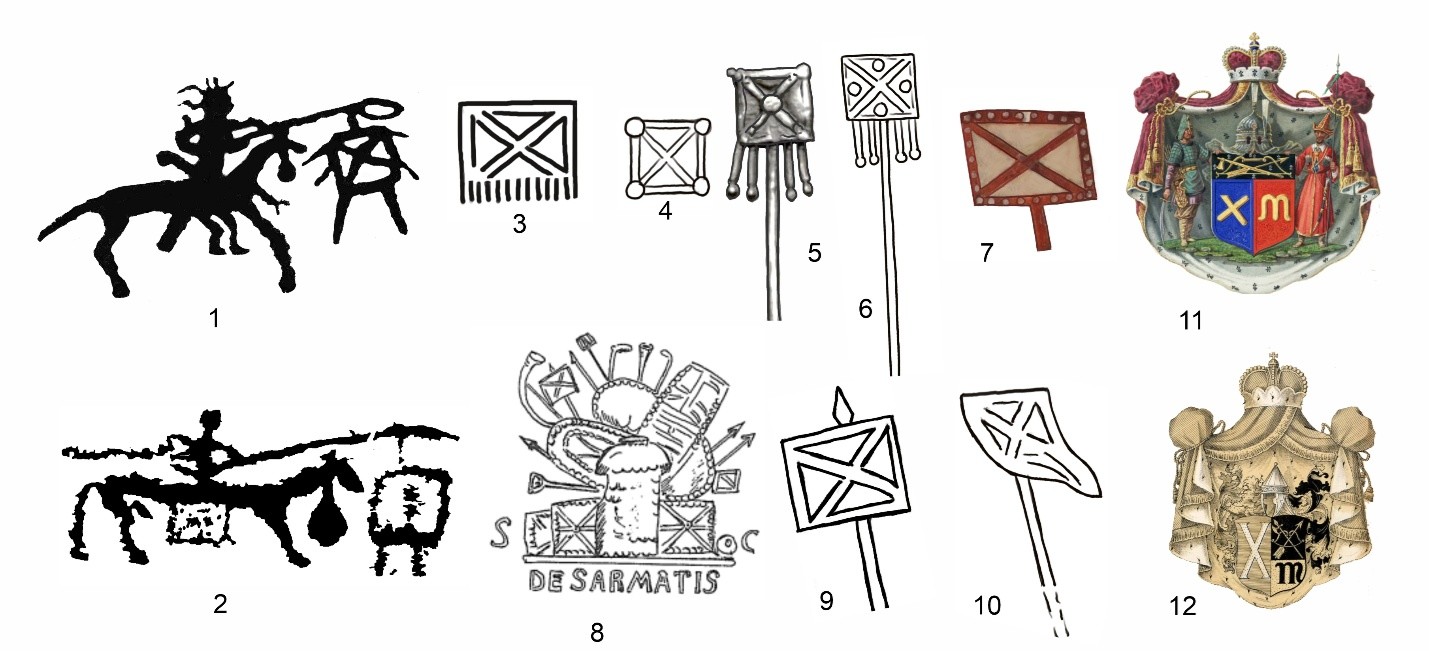
Ancient Turkic Battle Banner "Urungu"
Research Article - Published online first 01.02.2026.
Views: 782 / PDF downloads: 163DOI:
https://doi.org/10.32523/3080-129X-2026-154-1-01.02.2026-1Keywords:
military attributes, battle banner, standard, system of military insignia, military standard, "urungu" bannerAbstract
This article explores the ancient Turkic banner "urungu" ("khorugv" or "gonfalon" type of banner) as a distinct form of military insignia among Turkic-Mongol peoples. On this type of military banner, the fly is attached to a horizontal crossbar, which hangs from the flagshaft. Depictions of such banners are often found on ancient Turkic monuments of art. The features of this type of military attribute in ancient Turkic culture have not yet been comprehensively examined in academic research, making this topic particularly relevant for the study of military insignia among medieval nomads. This study aims to investigate the use of this form of military banner during the ancient Turkic period. The subject of the research is the specific types and structural features of the urungu standard. Unfortunately, no physical examples of urungu banners from the ancient Turkic period have survived. Written sources on this type of military insignia among the Turks are also very limited. Therefore, the primary sources for this study are visual materials – foremost among them, artistic monuments created by the Turks and other Turkic-speaking tribes, as well as images of similar battle and religious banners from other Eastern and Western cultures. These include rock carvings, wall graffiti, images on numismatic and heraldic materials, as well as mural paintings of various kinds. Additional sources included written accounts, archaeological evidence, and material artifacts. The study also draws on previous research and publications related to petroglyphs of medieval nomads, which depict this type of banner. To determine the function, specific forms, and methods of use of this symbolic object, comparative data from analogous military insignia of other peoples were also employed. The research applies both general scientific and specialized methods from the fields of history and art history. Through comparison and correlation with similar materials and sources, the study identifies shared features, distinctive traits, and unique aspects of this particular form of ancient Turkic military insignia. The classification of urungu images into distinct types based on visual similarity follows a typological methodology. As a result of this comprehensive analysis, the study reconstructs various forms and types of this nomadic military symbol, examines their geographic distribution, and traces the history of their application. The findings contribute to a deeper understanding of the system of military symbolism among nomads and shed light on the functional specifics of these banners.
Downloads
References
Casamayor-Monreal M. Religious Vexillology. Emblemata. 2013. Vol.19, pp.111–164.
Culture and art. https://culture-art.ru/прикладное-искусство-армении/. Data obrashcheniia 01.02.2025.
The Reliefs of Trajan’s Column. Edited and Historically Explained by Conrad Cichorius; Printed with the Support of the Royal Saxon Ministry of Culture and Public Education. First Plate Volume. Reliefs of the First Dacian War. Berlin: Published by Georg Reimer. 1896.
Długosz J. Annals or Chronicles of the Famous Kingdom of Poland. Warsaw: Scientific Publishing House PWN. 2009. Ks. 7-8. https://vk.com/wall-76284785_11399 Data obrashcheniia 12.05.2024.
Getty Images. https://www.gettyimages.fr/photos/gonfalon. Data obrashcheniia 04.08.2024.
Grünwedel A. Alt‑Kucha: Archaeological and Religious Studies of Tempera Paintings in Buddhist Cave Тemples of the First Eight Centuries CE. Berlin: Otto Elsner Verlagsgesellschaft. 1920. NII "Digital Silk Road". Toyo Bunko. https://dsr.nii.ac.jp/toyobunko/LFa-21/V-1/page-hr/0265.html.en
Istwánovits E., Kulcsár V. Sarmatians through the eyes of strangers. The sarmatian warrior. International connections of the Barbarians of the Carpathian Basin in the 1st-5th centuries A.D. Proceedings of the international conference held in 1999 in Aszód and Nyíregyháza. Aszód – Nyíregyháza. 2001. Pp.139-169.
Mesbah B. Configuring the Roots of Zahak Myth according to the Elamites Cylinder Seals (3rd Millen.BC.). Bagh-e-Nazar. 2018. Vol.14, no.56, pр.41-52. https://www.researchgate.net/profile/Bagh-E-Nazar/publication/325416900 Data obrashcheniia 01.05.2025.
Ramstedt’s G. ‘Kalmyk Dictionary’ was published in German. Helsinki: Suomakais-Ugrilainen Seura. 935. 560 р.
von. Le Coq A. Atlas of Art and Cultural History of Central Asia. Berlin. 1925. https://dsr.nii.ac.jp/toyobunko/VIII-5-B6-1/V-1/ Data obrashcheniia 04.08.2024.
Winder M. Catalogue of Tibetan manuscripts and xylographs, and catalogue of thankas, banners and other paintings and drawings in the Library of the Wellcome Institute for the History of Medicine. London: The Wellcome Institute for the History of Medicine. 1989. Рp.112. 12 color plates.
无声史域:平定西域献俘礼定卷 (Silent Epic: Scroll Painting of the Ceremony of Presenting Captives the Pacification of the Western Regions). https://history.ifeng.com/c/861rbxZdySk. Data obrashcheniia 21.02.2025.
Ariiskii simvol i znamya. Gosudarstvennyi shtandart drevnego Irana. 2024. https://maximus101.livejournal.com/207620.html. Data obrashcheniia 01.02.2025.
Akhmetzhan K. Voennaia simvolika drevnikh tiurkov (po izobrazitelnym istochnikam). Bulletin of L. Gumilyov Eurasian National University. Historical Sciences. Philosophy. Religious Studies. 2024. V.149, no.4, pp.63-87. https://doi.org/10.32523/2616-7255-2024-149-4-63-87. DOI: https://doi.org/10.32523/2616-7255-2024-149-4-63-87
Beikhaim V. Entsiklopediia oruzhiia. SPb: Saint Petersburg Orchestra Publ. 1995. 576 p.
Bobrov-Sosnovskii D. Tsari Baktrii i Indo-Baktrii. Monety Gretsii: ot arkhaiki do provintsii. 2019. https://www.coins.msk.ru/index.php/stati-i-materialy/monety-gretsii/59. Data obrashcheniia: 04.08. 2024
Boitsov M. Veksillologicheskie traditsii srednevekovoi Evropy. Signum. Center for Heraldic and Genealogical Studies. Institute of World History. Russian Academy of Sciences. Moscow: Institute of World History RAS. 2013. Is.7. Рp.14-75.
Weis G. Istoriia kultury narodov mira. Rastsvet Vizantii: Arabskie zavoevaniia. Moscow: Eksmo Publ. 2006. 144 p.
Veksillografiia. https://www.vexillographia.ru/russia/empirar9.htm#a1800. Data obrashcheniia 04.08.2024.
Gavrilov A. Khorugv u slavian i pragermanskoe "khrungo". Scholarly Notes of Yaroslav Mudry Novgorod State University. 2020. No.7(32), pp.1-6. https://doi.org/10.34680/2411-7951.2020.7(32).7.
Gaidukevich V. Bosporoskoe tsarstvo. Academy of Sciences of the USSR, Institute for the History of Material Culture named after N.Ya. Marr. Moscow–Leningrad: Publishing House of the Academy of Sciences of the USSR. 1949. 624 p.
Dal V. Tolkovyi slovar zhivogo velikorusskogo iazyka: (v 4 ch.). 3rd ed., revised and significantly enlarged, ed. and intro. by Prof. I.A. Boduen-de-Kurtene. Saint-Petersburg-Moscow: M.O. Volf Partnership Publ. 1909. Vol.4 (C-V). 1619, XII p.
Dvoryanskie rody Rossiiskoi imperii. Vol.2. Princes. Saint Petersburg: Vesti Publ. 1995. 264 p.
Dmitriev S. Znamennyi kompleks v voenno-politicheskoi kulture srednevekovykh kochevnikov Tsentralnoi (nekotorye voprosy terminologii i morfologii). Military-Historical Journal "PARA. BELLVM" SPb. 2002. No.14, pp.47-66. http://www.parabellum.vzmakh.ru/n14_s4.shtml. Data obrashcheniia 04.08.2024.
Dmitriev S. Znamia v voenno-politicheskoi kulture tiurko-mongolskikh kochevnikov. Journal of Sociology and Social Anthropology. Saint Petersburg. 2001. Vol.IV, no.4, pp.89-102.
Drevnetiurkskii slovar. Ed. by Nasilov D., Kormushin I. et al.; comp. by Borovkova T., Dmitrieva L., Zyrin A., Kormushin I. et al. 2nd revised ed. Astana: Nauka Publ. 2016. 760 p.
Znamena i shtandarty polkov, batalonov Rossiiskoi armii. Website "Vexillography". https://www.vexillographia.ru/russia/rarmy097.htm Data obrashcheniia 04.08.2024.
Ivanov K. Flagi gosudarstv mira. Moscow: Transport Publ. 1971. 229 p. ill.
Connolly P. Gretsiia i Rim. Entsiklopediia voennoi istorii. Moscow: Eksmo-Press Publ. 2000. 320 p.
Kormushin I. Tiurkskie eniseiskie epitafii. Teksty i issledovaniia. Moscow: Nauka Publ. 1997. 303 p.
Kormushin I. Tiurkskie eniseiskie epitafii: grammatika, tekstologiia. Ed. by Nasilov D. Institute of Linguistics Russian Academy of Sciences. Moscow: Nauka Publ. 2008. 342 p.
Kyzlasov L. Novyi pamiatnik Eniseiskoi pismennsti. Soviet Ethnography. Moscow: Science Publ. 1965. No.2, pp.104-113.
Qazaqstan tarihy turaly turki derektem, eleri. Köne türık bıtıktastary men eskertkışterı (Orkhon, Enisei, Talas). (Tiurkskie istochniki ob istorii Kazakhstana. Drevnetiurkskie nadpisi i pamiatniki (Orkhon, Enisei, Talas). Almaty: Daik-Press Publ. 2005. Vol.II. 252 p. + 144 p.
Maksimova A., Ermolaeva A., Mariiashev A. Naskalnye izobrazheniia urochishcha Tamgaly. Album. Alma-Ata: Art Publ. 1985. 144 p.
Margulan A. Sochineniia v 14 t. In: Vol.3. Petroglyphs of Saryarka. Engravings depicting the wolf totem. Vol.4. Stone statues of Ulytau. Almaty: Daik-Press Publ. 2003. 50 p. + incl. 246 p.
Marcellin A. Rimskaya istoriya. Translated from Latin by Yu. Kulakovsky, A. Sonni. Moscow: AST; Ladomir Publ. 2005. 631 p.
Mariiashev A., Rogozhinskii A. Naskalnye izobrazheniia v gorakh Eshkiolmes. Alma-Ata: Nauka Publ. 1991. 80 p. 2 leaves of ill.
Materialy po istorii russkikh odezhd i obstanovki zhizni narodnoi, izdavaemye po Vysochaishemu soizvoleniiu K. Prokhorovym. Saint Petersburg: Printing House of the Imperial Academy of Sciences. 1881. Is.I. 86 p. 72 pl. ill.
Medoev A. Graviury na skalakh. Sary-Arka. Mangyshlak. P.1. Alma-Ata: Flame Publ. 1979. 174 p. ill.
Melioranskii P. Turetskie elementy v iazyke "Slova o polku Igoreve". Proceedings of the Department of Russian Language and Literature. Saint Petersburg: Printing House of the Imperial Academy of Sciences. 1902. Vol.7. Book.2. Рp.273-302.
Menges K. Vostochnye elementy v "Slove o polku Igoreve". Leningrad: Nauka Publ. Leningrad Branch. 1979. 268 p. Mekhovskii M. Traktat o dvukh Sarmatiiakh. Introduction, translation and commentary by S.A. Anninskii. Preface by B. Grekov. Institute of History Academy of Sciences of the USSR. Moscow-Leningrad: Volodarsky Printing House. 1936. 288 p.
Mukhareva A., Munkhbayar Ch., Sukhbaatar B. Naskalnye izobrazheniia Derstiin Khutul v Mongolii. Proceedings of the "Tomsk Petroglyphs" Museum-Reserve. Kemerovo. 2018. Is.8. Рp.67-76.
Nefedkin A. Voennoe delo sarmatov i alan (po dannym antichnykh istochnikov). Saint Petersburg: Faculty of Philology Saint Petersburg State University. 2011. 304 p.
Okladnikov A. Kon' i znamia na lenskikh pisanitsakh. Turkological Collection. I. Moscow-Leningrad: Publishing House of the Academy of Sciences of the USSR. 1951. Pp.143-155.
Okladnikov A., Zaporozhskaia V. Lenskie pisanitsy. Naskalnye risunki u derevni Shishkino. Moscow–Leningrad: Publishing House of the Academy of Sciences of the USSR. 1959. 200 p. with tables.
Poppe N. O tiurkskikh leksicheskikh zaimstvovaniiakh v "Slove o polku Igoreve" i "Zadonshchine". Proceedings of the Department of Old Russian Literature. Saint Petersburg. 2004. Vol.LV. Рp.153-161.
Rudenko S. Kul'tura khunnov i Noinulinskie kurgany. Moscow-Leningrad: Publishing House of the Academy of Sciences of the USSR. 1962. 206 p.
Samashev Z. Kone turki grafikasy. (Drevnetiurkskaia grafika). Astana: Prosper Print. 2013. 316 p.
Samashev Z. Naskalnye izobrazheniia Zhetysu. Baianzhurek. Astana: Publishing Group of the Branch of the A. Margulan Institute of Archaeology in Astana. Astana. 2012. 240 p.
Samashev Z. Naskalnye izobrazheniia Verkhnego Priirtysh'ia. Alma-Ata: Nauka Publ. 1992. 288 p.
Slovar' tiurkizmov v russkom iazyke. Compiled by E. Shipova. Alma-Ata: Science of the Kazakh SSR. 1976. 444 p.
Sovetova O., Mukhareva A. Ob ispolzovanii znamion v voennom dele srednevekovykh kochevnikov (poizobrazitelnym istochnikam). Archaeology of Southern Siberia. Kemerovo: Publishing House of Kuzbass Universities. 2005. Is.23. Рp.92-105.
Vasmer M. Etimologicheskii slovar' russkogo iazyka. Transl. from German and add. by O. Trubachev. 2nd ed., stereotyped. Moscow: Progress Publ. 1987. Vol.4 (T–Iashchur). 864 p.
Foli D. Entsiklopediia znakov i simvolov. Transl. from English. 2nd ed. Moscow: Veche; AST Publ. 1997. 512 p.
Published
Issue
Section
License
Copyright (c) 2026 K. Akhmetzhan

This work is licensed under a Creative Commons Attribution-NonCommercial-NoDerivatives 4.0 International License.