
Stadial and Local Variants of the Great Steppe Civilization
Research аrticle
Views: 304 / PDF downloads: 206DOI:
https://doi.org/10.32523/3080-129X-2026-156-3-96-114Keywords:
civilization, the civilizational concept, nomadism, mobility, developmental stages, local civilizations, polycentric systemAbstract
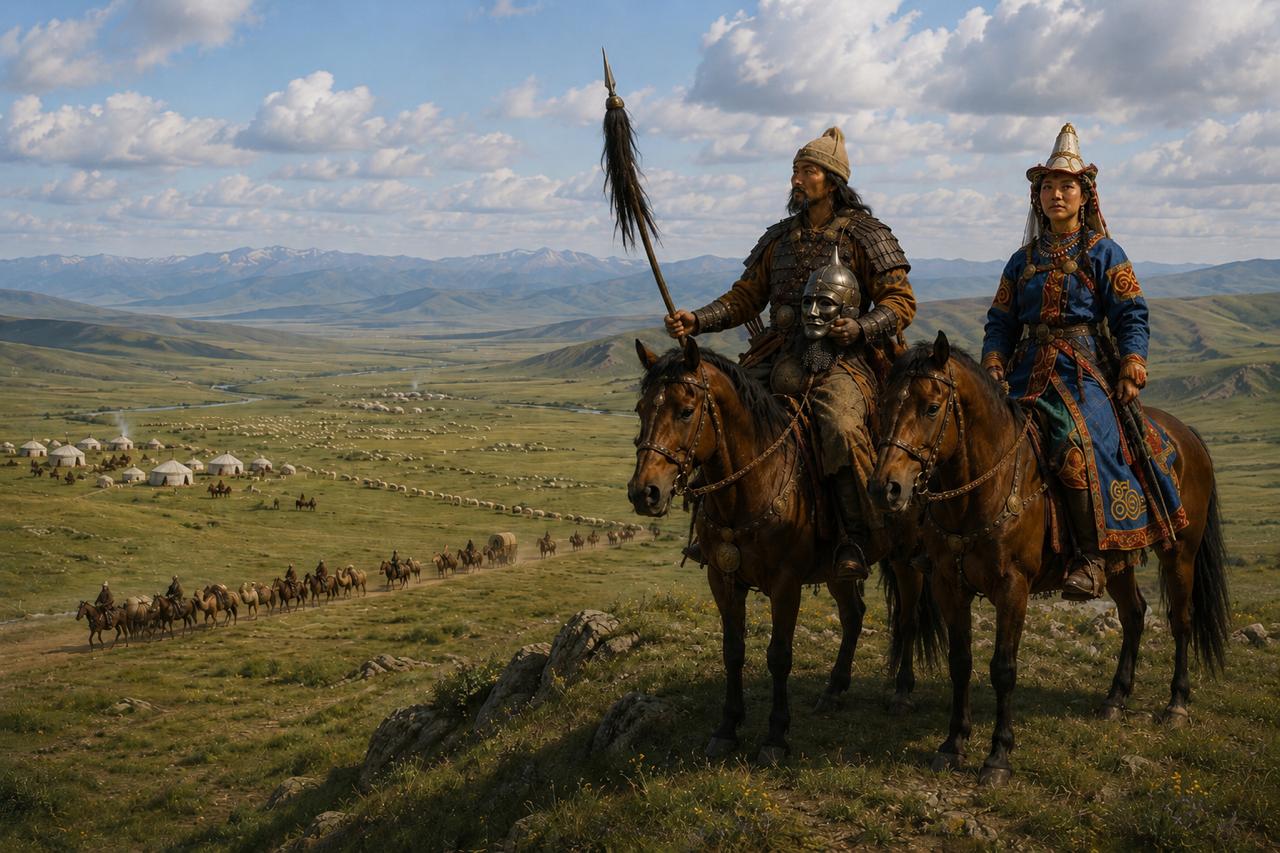
The paper examines the problem of the civilizational interpretation of the history of the Great Steppe and the need to overcome the fragmentation of the traditional historical narrative, in which the societies of the Saka, Huns, Turks, and other nomadic formations are interpreted as isolated ethnopolitical entities. The object of the study is the civilization of the Great Steppe as an integral historical and cultural system that developed over a long period and included a number of stadial and local forms. The aim of the work is to provide a theoretical interpretation of this civilization as a polycentric and dynamic system possessing a stable structural core and capable of reproducing itself under various natural-climatic, political, and cultural conditions. The methodological foundation of the study is based on a synthesis of civilizational, systemic, and historical-anthropological approaches. The civilization of the Great Steppe is considered as an open historical system in which economic practices, military organization, social structure, and symbolic culture function as interrelated elements. Special attention is given to mobility as the fundamental structural principle of steppe societies, which determined the forms of social integration, political consolidation, and cultural continuity. The empirical basis of the analysis consists of interpretative models developed within the fields of nomadic studies, archaeology, and historical anthropology. The results of the study show that the formation of the civilization of the Great Steppe is associated with the transition to mobile pastoralism and the domestication of the horse during the Eneolithic period, which ensured a high level of mobility and led to the emergence of a military-nomadic model of social organization. The main stadial stages in the development of the steppe civilizational system are identified as the Saka-Scythian, Hunnic-Sarmatian, and Turkic stages, each reflecting successive transformations of a single civilizational matrix. It is established that during the medieval period, local variants of this civilization were formed, including the Turkic-Muslim and Mongol-Buddhist cultural areas, as well as adaptive forms in Southern Siberia, Yakutia, and along the western frontiers of the steppe world. It is concluded that the civilization of the Great Steppe represents a multipolar historical system characterized by stable invariant features, including a mobile pastoral economic system, a military-hierarchical organization of society, a clan-based social structure, the sacralization of power, and a distinctive type of spatial thinking. The proposed approach makes it possible to interpret the succession of ethnonyms and political formations not as ruptures in historical tradition, but as successive stages in the development of a unified civilizational complex. The results obtained provide a theoretical basis for a more comprehensive interpretation of the history of steppe societies and their role in the civilizational dynamics of Eurasia.
Downloads
References
City invisible: A Symposium on urbanisation and cultural development in the ancient Near East. University of Chicago Press, Chicago. 1960. 448 p.
Chase-Dunn C., Hall T.D. Rise and Demise: Comparing World-Systems. Westview Press, 1997. 203 p.
Childe G. The Urban Revolution. V. Gordon Childe. The Town Planning Review. Apr. 1950. Vol.21, no.1, pp.3-17. Published by: Liverpool. DOI: https://doi.org/10.3828/tpr.21.1.k853061t614q42qh
Taagepera R. Size and Duration of Empires: Systematics of Size. Social Science Research. 1978. No.7, pp.108-270. DOI: https://doi.org/10.1016/0049-089X(78)90007-8
Shorayev B., Darmenov R. Islam and the Oghuz in the Aral Region (on Studies of the Jankent Settlement). Gumilyov Journal of History. 2025. Vol.152, no.3S1, pp. 68-83, https://doi.org/10.32523/3080-129X-2025-152-3S1-68-83. DOI: https://doi.org/10.32523/3080-129X-2025-152-3S1-68-83
Wilkinson D. Central Civilization. Civilization and World Systems: Studing World-Historical Change. Walnut Creek, CA: Altamira Press. 1995. 324 p.
Abaev N., Ajupov N. Tjengrianskaja civilizacija v duhovno-kul'turnom i geopoliticheskom prostranstve Central'noj Azii. Chast' 1. Tjengrianstvo i jetno-jekologicheskie tradicii tjurko-mongol'skih narodov Vnutrennej Azii. Abakan. 2009. 250 p.
Alaev L. Smutnaja teorija i spornaja praktika: o novejshih civilizacionnyh podhodah k Vostoku i k Rossii. Historical Psychology and the Sociology of History. 2008. No.2, рр.87-112.
Bakirova A. K voprosu o ponimanii kategorii “stepnaja civilizacija” v ramkah civilizacionno-kul'turnogo podhoda. Scientific Notes of the V. I. Vernadsky Crimean Federal University. Legal Sciences. 2018. Vol.4(70), no.2, рр.3-8.
Bartold V. Dvenadcat' lekcij po istorii tureckih narodov Srednej Azii. Sochinenija. Vol.V. Moscow.: Nauka. 1968. 757 p.
Botalov S. Kochevaia tsivilizatsiia Evrazii v prostranstve i vremeni. Bulletin of South Ural State University. Series: Social Sciences and Humanities. 2006. No.17(72), pp.14-20.
Botalov A. Kochevnicheskii gorod kak osoboe kul’turnoe iavlenie kochevoi tsivilizatsii Evrazii. Bulletin of Chelyabinsk State University. 2009. No.28(166). Istorija. Issue.34, pp.13-19.
Burovskij A. Stepnaia skotovodcheskaia tsivilizatsiia: kriterii opisaniia, analiza i sopostavleniia. Civilization. Is.3. Moscow.1995. Рp.151-164.
Gribovskij V. Kartyna ‘Kozak Mamai’: vytyky obrazu y nogayski paraleli. Ukraїna v Central'no-Shіdnіj Єvropі. Is.19-20. Kiїv: Іnstitut іstorії Ukraїni. 2021. Pp.285-334.
Gumilev L. Tysjacheletie vokrug Kaspija. Moscow: Mishel' i Ko. 1993. 336 р.
Zheleznjakov A. Kochevaia tsivilizatsiia: tupik ili perspektivy razvitiia. Proceedings of Higher Educational Institutions. Sociology. Economics. Politics. 2009. No.2, pp.58-61.
Zheleznjakov A. Mongol’skaia tsivilizatsiia: istoriia i sovremennost’. Teoreticheskoe obosnovanie atlasa. Moscow: Publ. house “The Whole World". 2016. 288 p.
Zajbert V. Botaj. U istokov stepnoi tsivilizatsii. Almaty: Balausa. 2011. 480 p.
Isaev K. Tsivilizatsiia kochevnikov: unikal’nost’ fenomena i ego vklad v razvitie mirovoi tsivilizatsii. Proceedings of Higher Educational Institutions. 2012. No.1, pp.176-179.
Kazhenova G. Tsivilizatsiia evraziiskikh kochevnikov v prizme nauchnykh paradigm. History of the Homeland. 2016. No.4(76), pp.5-11.
Kazachestvo v tiurkskom i slavianskom mirakh. Kazan': Institut arheologii im. A.H. Halikova AN RT. 2018. 804 p.
Kozodoj V. Civilizacija sibirskih kyrgyzov. Novosibirsk: (b.i.). 2025. 748 p.
Kozybaev M. Kazahstan na rubezhe vekov: razmyshlenija i poiski. Almaty: Gylym. 2000. 388 p.
Kozybaev M. i dr. Kljuch i vrata k aziatskim stranam. Kazakhstanskaya Pravda. May 16, 1991.
Koppan Chaji Laslo. Stepnaja civilizacija i region Urala. Chelyabinsk Humanitarian. 2010. No.3, pp.138-146.
Kumekov B. O stepnoj civilizacii. Kazakh Civilization in the Context of the World Historical Process. Proceedings of the International Conference. May 7–8, 2003. Almaty. 2003. Рp.72-77.
Martynov A. Dva etapa razvitiia stepnoi skotovodcheskoi tsivilizatsii. Problems of the History and Culture of the Nomadic Civilizations of Central Asia. Ulan-Udje: BNC SORAN. 2000. Рp. 80-84.
Masanov N. Kochevaia tsivilizatsiia kazakhov: osnovy zhiznedeiatel’nosti nomadnogo obshchestva. Almaty: Socivest, Moscow: Gorizont. 1995. 320 p.
Masson V. Pervye civilizacii. Leningrad: Nauka. 1989. 268 p.
Nazarbaev N. Sem' granej Velikoj stepi. Official website of the President of the Republic of Kazakhstan. November 21, 2018. Electronic resource. https://www.akorda.kz/ru/events/akorda_news/press_conferences/statya-glavy-gosudarstva-sem-granei-velikoi-stepi Accessed on 01.02.2026
Orazbaeva A. Tsivilizatsiia kochevnikov evraziiskikh stepei. Almaty: “Dajk-Press”. 2005. 311 p.
Samashev Z., Bokovenko N., Chotbaev A., Kariev E. Kul’tura sakov i skifov velikogo poiasa evraziiskikh stepei. The World of Greater Altai. 2016. No.2(4.2), pp. 824-848.
Safarov R. O roli tiurok v rasshirenii musul’manskogo areala. The Turkic-Muslim World: Identity, Heritage, and Prospects for Study. Kazan': Publ. Kazan. un-ta 2015. Рp.261-271.
Suraganova, Z., Burbaeva S., Tolegenuly K. The Medieval Settlement of Bozok: From a Cult Center to a Cultural Manifesto of Steppe Eurasia: Research аrticle”. Gumilyov Journal of History. 2026. Vol.155, no.2, pp.13-33, https://doi.org/10.32523/3080-129X-2026-155-2-13-33 DOI: https://doi.org/10.32523/3080-129X-2026-155-2-13-33
Tojnbi A. Dzh. Postizhenie istorii. Moscow: Publ. Progress. 1996. 736 p.
Frolov Je. Problema tsivilizatsii v istoricheskom protsesse. Vestnik of Saint Petersburg University. History. 2006. No.2, pp.96-100.
Tsarkov O. Ocherki istorii Saha. Tajga i Velikaja Step'. Concorde. 2022. No.1, pp.47-96.
Jepistoljarnoe nasledie kazahskoj pravjashhej jelity 1675-1821 gg. Collection of historical documents in 2 volumes. Volume I: Letters of the Kazakh rulers. 1675-1780. Almaty: ABDI Company JSC. 2014. 689 p.
The epistolary legacy of the Kazakh ruling elite of 1675-1821 Collection of historical documents in 2 volumes. Volume I: Letters of the Kazakh rulers. 1675-1780 Almaty: ABDI Company JSC. 2014. 689 p
Published
Issue
Section
License
Copyright (c) 2026 E. Abil , A. Kuzembayuly

This work is licensed under a Creative Commons Attribution-NonCommercial-NoDerivatives 4.0 International License.