
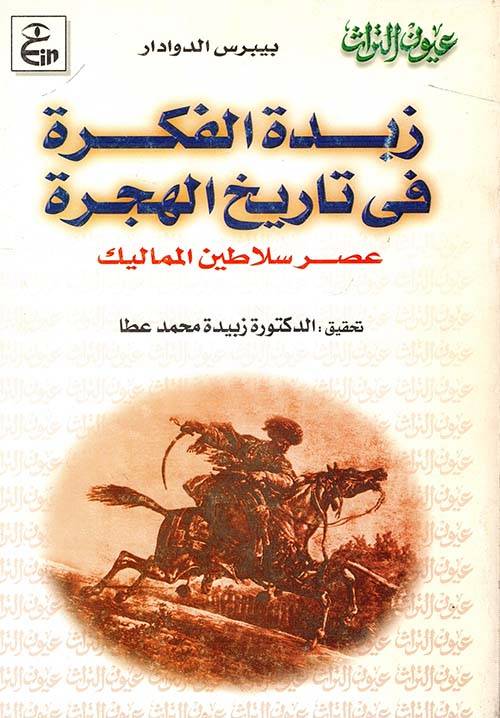
The Chronicle of Baybars al-Manṣūrī al-Nāṣirī ‘Zubda(t) al-Fikra(t) fī Tārīkh al-Hijra(t)’ in the Studies of the Mamluk State in Egypt in the Early Bahri Period
Research Article
Views: 540 / PDF downloads: 686DOI:
https://doi.org/10.32523/3080-129X-2026-154-1-60-75Keywords:
‘Zubda(t) al-Fikra(t) fī Tārīkh al-Hijra(t)’, Baybars al-Manṣūrī, Egypt, Mamluks, Bahri, Richards, the Golden Horde, Mamluk ChroniclesAbstract
The article deals with the place and role of the ‘Zubda(t) al-Fikra(t) fī Tārīkh al-Hijra(t)’ by Baybars al-Manṣūrī (d. in 1325) in the contemporary Mamluk studies, as well as with posssibilty of its wider implementation in Middle East studies. The author of this Chronicle was a prominent amīr and official in the early Bahri period. Despite the importance of the Chronicle in deep understanding of the early Mamluk history, the political development of the Mamluk state, and the transformation of its political institutions under the influence of the Turk legacy of the first Mamluk elite, this source was published according to academic standards relatively late, only in 1998 by Donald Richards. After that, ‘Zubda(t)...’ is commonly cited in almost all academic works devoted to the Bahri period. The article considers the history of academic research on the source, various approaches to its significance, as well as possible implementation in studies beyond the Mamluks state, particularly for studying the history of the Golden Horde and the Ilkhanate. The article summarizes the importance of ‘Zubda(t)...’ because of the following considerations: a) it is still insufficiently studied and brings new information into the Mamluk studies; b) Baybars al-Manṣūrī is a very rare example of a member of the highest military and political elites who composed a full historic chronicle. Moreover, he personally participated in many events which are mentioned in his work; c) During to his Turk (presumably Kipchak) origin, Baybars al-Manṣūrī was aware of traditional Turk political and social institutes and made a special emphasis on these elements, while they were unclear and of less importance for later Mamluk authors; d) The Chronicle covers a relatively long period of time (1252-1307 AD), which allows making statistic observations and calculations, as well as to trace the evolution of main political and social institutes within the early Bahri period.
Downloads
References
Ahmad ibn ʿAlī al-Maqrīzī. Kitāb al-Sulūk li-maʿrifat duwal al-mulūk. Beirut. 1997. Vol.2. 533 p.
Ashtor E. Baybars al-Manṣūrī. In: The Encyclopaedia of Islam. Vol.1. Leiden: Brill. 1986. Pp.1187–1188.
Badr al-Dīn Maḥmūd al-ʿAynī. ʿIqd al-Jumʿān fī Tārīkh Ahl al-Zamān. Cairo. 2010. 558 p.
Baybars al-Manṣūrī. Zubdat al-Fikra fī Ta’rīkh al-Hijra. Berlin; Beirut: Das Arabische Buch. 1998. 488 p.
Bernfeld S. Retribution. In: Jewish Encyclopedia. Vol.5. Eds. L. Katzenelson, D. Gintsburg. St. Petersburg. 1991. Pp.671-683.
Chronicles of Qalāwūn and his son al-Ashraf Khalīl. Translated by David Cook. Routledge. 2020. 436 p.
Filipau A. The formation of the Mamluk state in Egypt in the second half of the 13th century. Minsk: IVC of the Ministry of Finance. 2021. 352 p.
Gibb H. A. R. Arabic Literature: The Classical Period. Translated from English. Moscow: Oriental Literature Publishing House. 1960. 187 p.
Irwin R. The Middle East in the Middle Ages: The Early Mamluk Sultanate. 1250-1382. Carbondale: Southern Illinois University Press. 1986. 192 р.
Kuznetsov V. The Structure and Development of Arab-Muslim Historical Knowledge in the 8th-15th Centuries. Abstract of PhD dissertation (History), Institute of Oriental Studies, RAS. Moscow. 2010. 31 p.
Malik F. Dictionary of the Holy Qur’an with References and Explanation of the Text. Tilford: Islam International Publications Limited. 2006. 880 p.
Mazor A. The Topos of Predicting the Future in Early Mamluk Historiography. In: Mamluk Historiography – Revisited Narratological Perspectives. Stephan Conermann (ed). Bonn: V&R UP. 2018. Pp.103-120. DOI: https://doi.org/10.14220/9783737007221.103
Mikulskii D. Muslim Historiography as the Foundation of the Modern Historical Consciousness of Muslims. Electronic resource. Available at: http://www.hist.msu.ru/Labs/UkrBel/mikulski1.htm (accessed 03.11.2019).
Porsin A. The History of the Golden Horde in the Late 13th – Early 14th Centuries in the Work of Rukn al-Dīn Baybars al-Manṣūrī “Zubdat al-Fikra”. Kazan: Sh. Marjani Institute of History. 2018. 276 p.
Richards D. Introduction. In: Baybars al-Manṣūrī, Zubdat al-Fikra fī Ta’rīkh al-Hijra. Berlin; Beirut. 1998.
Rosenthal F. History of Muslim Historiography. Leiden: Brill Academic Publishers. 1997. 669 p.
Sabitov Zh., Tuleubaeva S. Zubdat al-Fikra as a Source on the History of Kay-Kāwus II and Urbay-Khatun. Bulletin of KazNU. Oriental Studies Series. 2024. No.4(111), pp.4–12. DOI: https://doi.org/10.26577/JOS.2024.v111.i4.01
Sidarus A. The Mamluk Historian al-Amīr Baybars al-Manṣūrī al-Dawādār (d. 725/1325) and His Coptic Secretary al-Qiss al-Shams Abū al-Barakāt Ibn Kabar (d. 724/1324): A New Assessment. American Journal of Humanities and Social Sciences Research. 2020. Vol.4, no.1, pp.141–148.
Timokhin D., Tishin V. Review of A. A. Porsin’s Book The History of the Golden Horde in the Late 13th – Early 14th Centuries in the Work of Rukn al-Dīn Baybars al-Manṣūrī ‘Zubdat al-Fikra’. Golden Horde Review. 2020. Vol.8, no.2, pp.391–410. DOI: https://doi.org/10.22378/2313-6197.2020-8-2.391-410
Tiesenhausen V. Collection of Materials Relating to the History of the Golden Horde. Vol.1: Extracts from Arabic Sources. SPb. 1884. 564 p.
Tuleubaeva S. The Work of Emir Rukn al-Dīn Baybars al-Manṣūrī al-Dawādār Zubdat al-Fikra fī Tārīkh al-Hijra as an Important Source on the Reign of Sultan Baybars. Questions of Oriental Studies. 2024. No.1, pp.96–103.
Tuleubaeva S. Turkisms and Mongolisms in the Work of Emir Rukn al-Dīn Baybars al-Manṣūrī al-Dawādār Zubdat al-Fikra fī Tārīkh al-Hijra. Journal of the National Congress of Historians. 2025. Vol.1, no.1, pp.53-68. DOI: https://doi.org/10.65076/3105-0042.2025.1.53.68
Published
Issue
Section
License
Copyright (c) 2026 A. Filipau

This work is licensed under a Creative Commons Attribution-NonCommercial-NoDerivatives 4.0 International License.