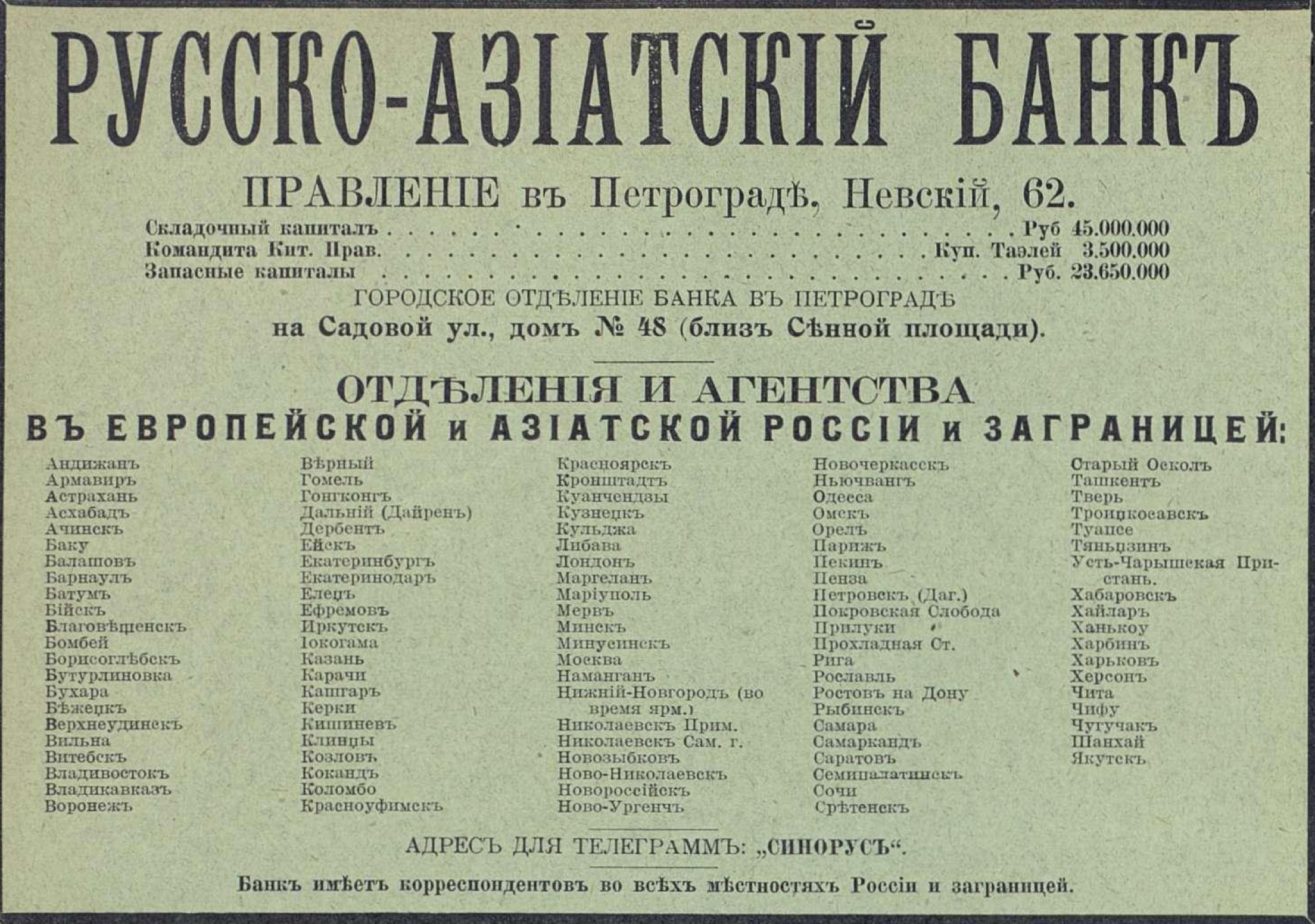
History of the Main Operations of the Verny Branch of the Russo-Asiatic Commercial Bank
Research аrticle
Views: 155 / PDF downloads: 104DOI:
https://doi.org/10.32523/3080-129X-2026-156-3-52-65Keywords:
Verny, Semirechye, bank, credit, deposit, economy, war, inflation, merchants, modernizationAbstract
The subject of this study is the activities of the Verny branch of the Russo-Asiatic Commercial Bank in the socio-economic space of the Semirechye region in the early 20th century. In Soviet historiography, banks were understood as instruments of "colonialists," both Western and Russian. The author, unlike Soviet and post-Soviet researchers, believes that banks did not become "monopolists" in the economies of Central Asia. The author believes that the main reason is the bank's adaptation to the existing economic relations in the Turkestan and Steppe Governorates. The topic of the work is the analysis of the financial, economic, credit and deposit activities of a banking institution in the context of economic growth, natural disasters and the transformations caused by the First World War. The purpose of the study is to identify the operating features of the Verny branch, determine its role in the development of the regional economy, and analyze the dynamics of active and passive transactions, the structure of the client base and financial results in 1911-1916. Since these aspects are not fully reflected in the title of the work, their disclosure seems methodologically necessary. The methodological basis of the study consists of historical and economic analysis, systematization of archival statistical data, and a comparative analysis of the bank's annual financial indicators. The use of quantitative analysis of bank statements made it possible to identify trends in changes in turnover, deposits, loans and profits in the context of wartime and inflation. In interpreting the materials, the author relies on Eisenstadt’s theory of “multiple modernizations”. The study established that the Verny branch played a key role in servicing the region's commercial and industrial operations, financing merchants, resellers, agricultural exporters, and livestock breeders. This study concludes that the Verny branch made a significant contribution to the development of commodity-money relations and the financial infrastructure of the Semirechye region. These findings allow us to consider the branch's activities as an important factor in the economic modernization of the region, up until the nationalization of the banking system in 1918.
Downloads
References
Alimdzhanov B. The Activities of the Andijan Branch of the Russo‑Asian Commercial Bank. Vestnik of Saint Petersburg University. Oriental and African Studies. 2019. Vol.11, is.3, pp.266-278 DOI: https://doi.org/10.21638/spbu13.2019.301
Aminov A. Economic Development of Central Asia (Colonial Period). Tashkent: Gosizdat UzSSR. 1959. 298 p.
Chokobaeva A. Frontiers of Violence: State and Conflict in Semirechye, 1850-1938. A thesis submitted for the degree of Doctor of Philosophy of The Australian National University. 2016. 196 p.
Fridman Ts.L. Banks and Credit in Pre‑Revolutionary Kazakhstan (1900-1914). Alma‑Ata: Kazakhstan. 1974. 175 p.
Eisenstadt S.N. Multiple Modernities. Daedalus. 2000. No.129(1), pp.1-29. DOI: https://doi.org/10.1177/03058298000290031201
Gindin I. Banks and Economic Policy in Russia (19th – Early 20th Century). Selected Works. Essays on the History and Typology of Russian Banks. Moscow: Nauka. 1997. 622 p.
Kastelskaya Z. D. From the History of the Turkestan Region (1865-1917). Moscow: Nauka. 1980. 123 p.
Keating J. On Arid Ground: Political Ecologies of Empire in Russian Central Asia. Oxford; New York: Oxford University Press. 2022. 252 p. DOI: https://doi.org/10.1093/oso/9780192855251.001.0001
Khotamov N.B. The Role of Banking Capital in the Socio‑Economic Development of Central Asia (Early 1890s-1917). Dushanbe: Donish. 1990. 319 p.
Kitanina T.M. War‑Inflation Cartels in Russia, 1914-1917. The Putilov-Stakheev-Batolin Concern. Leningrad: Nauka. 1969. 179 p.
Lavrentyev V. A. Capitalism in Turkestan. Moscow: Kommunisticheskaya akademiya. 1930. 160 p.
Makhkamova N. The Social Structure of Society in the Territory of Uzbekistan: Traditions and Transformations (Late 19th Century – 1930s). Tashkent: Aloqachi. 2009. 323 p.
Mironov B. The Cost of Empire Unity in Late Imperial Russia. Studia Slavica et Balcanica Petropolitana. 2019. No.1, pp.155-182. DOI: https://doi.org/10.21638/11701/spbu19.2019.112
Potapova N.Yu. The History of Entrepreneurship in Turkestan (Second Half of the 19th – Early 20th Century). Tashkent: UMÉD. 2011. 152 p.
Salomatina S. Russian and Soviet Imperial Banking in Asia in the 1890s-1920s. Asian Imperial Banking History. London: Pickering & Chatto Publishers. 2015. Pp.121-158.
Sadykov A.S. Economic Relations of Khiva with Russia in the Second Half of the 19th – Early 20th Century. TashGU. Issue 296. Tashkent: Nauka UzSSR. 1965. 183 p.
Vekselman M. Russian Monopolistic and Foreign Capital in Central Asia (Late 19th – Early 20th Century). Tashkent: Fan. 1987. 145 p.
Yuldashev A.M. Agrarian Relations in Turkestan (Late 19th – Early 20th Century). Tashkent: Uzbekistan. 1970. 256 p.
Published
Issue
Section
License
Copyright (c) 2026 B. Alimdzhanov

This work is licensed under a Creative Commons Attribution-NonCommercial-NoDerivatives 4.0 International License.